
Newton Previous Residents by Era
One Newton address can leave several trails, but the right starting source depends on the period. Begin with the current parcel to anchor the location, then move through the Middlesex South Registry of Deeds for transaction history. Directory house sections and resident lists help with people associated with the address between transfers. Census, maps, permits, newspapers, obituaries, and probate records can explain the gaps. They should be compared, not merged into a single claim.
| Source | Years It Covers | Where Held | What It Shows |
|---|---|---|---|
| Newton MapGeo and Newton GIS | Current layer; parcel metadata updated June 2026 | Newton Assessor and Newton GIS | Current SBL, owner/address, value, sale and legal references |
| Middlesex South Grantor scans for Newton | 1896-1973 confirmed online | Middlesex South Registry serving Newton | Grantor, instrument, grantee, Book/Page, street and town |
| Newton Polk city directories | 1868-1934 and 1936-1985, generally biennial | Newton City Archives, Newton Free Library, Internet Archive | Address, person, occupation, and spouse clues |
| Newton resident lists and federal census | 1884-1995 lists; 1950 public; 1940 Newton ED pages 9-420 to 9-444 | Digital Commonwealth, Internet Archive, NARA, Newton Free Library | Household entries, age, relationship, and address context |
| Newton permits, maps, and newspapers | Permit plans after 1911; map and newspaper runs vary | Newton ISD, Newton Free Library, Library of Congress, BPL | Work dates, lot continuity, moves, deaths, and notices |
Use a present-day address with the City of Newton Assessor / MapGeo Property Quick Search or the Newton GIS Browser. The public parcel fields are owner and situs information, not a complete list of occupants. The trail becomes historical only after the last Book/Page reference and its deed image are checked.
Newton Previous Residents Start With a Parcel
Record the street number and spelling as used now, the village, SBL, current owner, sale clue, and Legal1 last Book/Page when they appear. Newton MapGeo permits address, co-owner name, owner, and SBL searching. The Newton GIS Browser has an address box at upper left and can add parcel, historic, ward, precinct, ZIP, zoning, flood, and building layers. Its parcel data can provide a durable bridge when an old street name or postal label does not match a modern address.
SBL, also called MAP_PAR_ID in the Newton parcel layer, identifies a parcel. The layer exposes address number and street, Current Owner, land use, zoning, lot size, frontage, sale date and price, total value, year built, and Legal1 for the last Book/Page. It has about 24,200 Newton polygons. A GIS boundary update is not a transfer date, and owner information is not proof that every person at the address lived there.
Newton is a city of thirteen villages, while it has ten postal ZIPs. Newton Centre and Newton Center, a historic village label, and a postal label can each appear in a search. Chestnut Hill ZIP 02467 also reaches Brookline and Boston. Preserve the municipality and legal reference before moving to another custodian.
Newton Previous Residents and Book/Page
Open the Newton parcel's Book/Page in Middlesex South Registry of Deeds / MassLandRecords. The Registry serves Newton within Middlesex County, Massachusetts. Confirm the Newton town, address or legal description, parties, recording date, document type, and image. Separate Recorded Land, Registered Land, Plans, and Registered Land Plans are available. The legal description can survive an address change better than a house number, while a plan can explain why a lot reference changed.
Read the document type before following a name. A mortgage is not an ownership transfer. A discharge shows lien release, not a new household. A deed may involve a trustee, entity, executor, or probate transaction. Mark each link as a transfer, lien, discharge, plan, probate, or another instrument, then keep its image and Book/Page reference. This prevents a loose name match from becoming a false chain.
Note: A deed names transaction parties and legal interests, so a directory or census is still needed to support a past household association.
Newton Previous Residents Through the Deed Chain
The Newton backward method begins with the current buyer. On a purchase deed, the grantee is the party who received the property and the grantor is the party who transferred it. Search that seller as a grantee in the earlier period to locate the prior acquisition, then repeat. Use Newton property or address criteria when indexed, but switch to grantor, grantee, Book/Page, and legal description when a street variant blocks the search.
- Search MapGeo, copy the SBL, current owner, sale reference, and Legal1 Book/Page.
- Open the Book/Page image and confirm the Newton property with its town, address or legal description, parties, recording date, and instrument type.
- Identify the purchase deed's grantor as the earlier transferor, then search that person or entity as grantee for the prior purchase.
- Repeat backward, recording parties, date, instrument, Book/Page, image, and any change in the legal description.
- Check plans, mortgages, discharges, or probate instruments as context without treating them as a transfer unless the document says so.
- Grantor
- The party transferring an interest in the property in a recorded document.
- Grantee
- The party receiving that interest. In a backward deed search, an earlier owner is often found by searching the later seller as a grantee.
- Chain of title
- The documented sequence of transfers and related instruments for a parcel, supported by the actual records.
- Legal description
- The land description used in deeds and plans. It can be more stable than a street address when names, numbers, or village labels differ.
Newton Grantor Index Records
Middlesex South announced on October 21, 2025 that its Grantor Indices for 1896 through 1973 were available online at no charge. The confirmed range improves historical Newton name access, but it does not establish an earlier name-index cutoff. Where a document is scanned but not name-searchable, a known Book/Page is important. The Registry's unindexed-property mode exposes Book 1 through 1024 ranges.
The Registry announcement on the Grantor Index scans is the source for that verified range. Its practical benefit is not a complete people list. It lets a researcher compare recorded names, instruments, grantees, Book/Page, town, and street where those fields are present, then return to the document image for the actual record.
The official route for an older or unindexed reference is MassLandRecords unindexed-property mode, Registry staff, the in-person research room, or a narrow request that supplies the known property and date range. Do not turn an unknown name into a broad request. The Registry's current online images are free, and the Registry also warns Newton property owners against unsolicited deed-copy offers.
See the Middlesex South grantor-index announcement before using the confirmed online range.
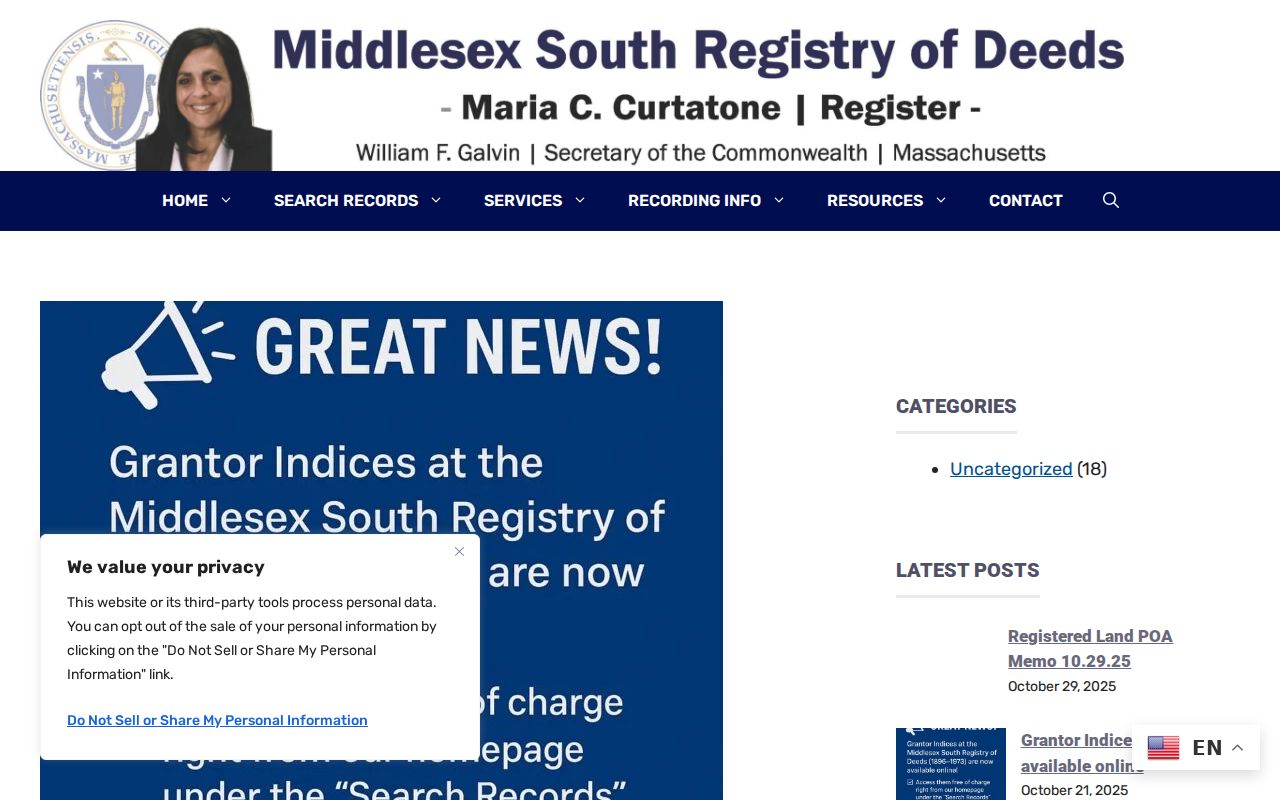
The notice documents the date range that was added online. It does not make earlier material name-searchable, so Book/Page and staff access still matter when tracing an older Newton transfer.
Newton Directory Records Between Deeds
Newton deeds follow land interests, not everyone who lived at a Newton address. To trace a past household, use the house or street section of a Newton Polk directory to find names tied to the address, then check the alphabetical section for occupation, spouse or widow notation, and a second address. Newton's documented directory run is 1868-1934 and 1936-1985, generally biennial with exceptions. Newton Free Library identifies its house-directory section from 1889 onward. It is the local reverse path, rather than a separately verified full reverse-directory series.
Pair a Newton directory date with resident lists and census records. Newton lists run from 1884-1942 through Digital Commonwealth and 1943-1995 through Internet Archive. The 1950 federal census is public. NARA also identifies 1940 Newton enumeration-district material, while older census images and indexes require archival or library access. Copy spelling, initials, occupation, spouse or widow notation, village, and address exactly. A common name needs another marker such as age, spouse, parcel, or work description.
- Find the house section for the nearest directory year and copy each listed name and notation.
- Check the alphabetical section in that same edition for address, occupation, and cross-reference details.
- Repeat at the nearest available years before and after, allowing for publication gaps.
- Test an intervening year in a resident list, then compare the closest federal census image and enumeration district.
- Use deed dates, newspapers, or obituaries to explain a move, death, or ownership change without treating a single record as conclusive.
For the directory collection itself, use the Newton Directory Book. It contains the access details for digitized PDFs, the Local History Room, and the companion indexes rather than repeating the full shelf description here.
Newton Census Records by Address
The National Archives 1950 Newton search is a useful Newton household check because it reaches the most recent fully public federal census. Newton's location search shows 116 enumeration districts. Name OCR can be wrong, so use a district description and the census image when a name result does not fit the Newton address trail. For 1940, official roll references identify Newton pages 9-420 through 9-444. The census belongs beside directories and deeds, not in place of them.
Use the National Archives 1950 Newton location search to locate the relevant district or image.
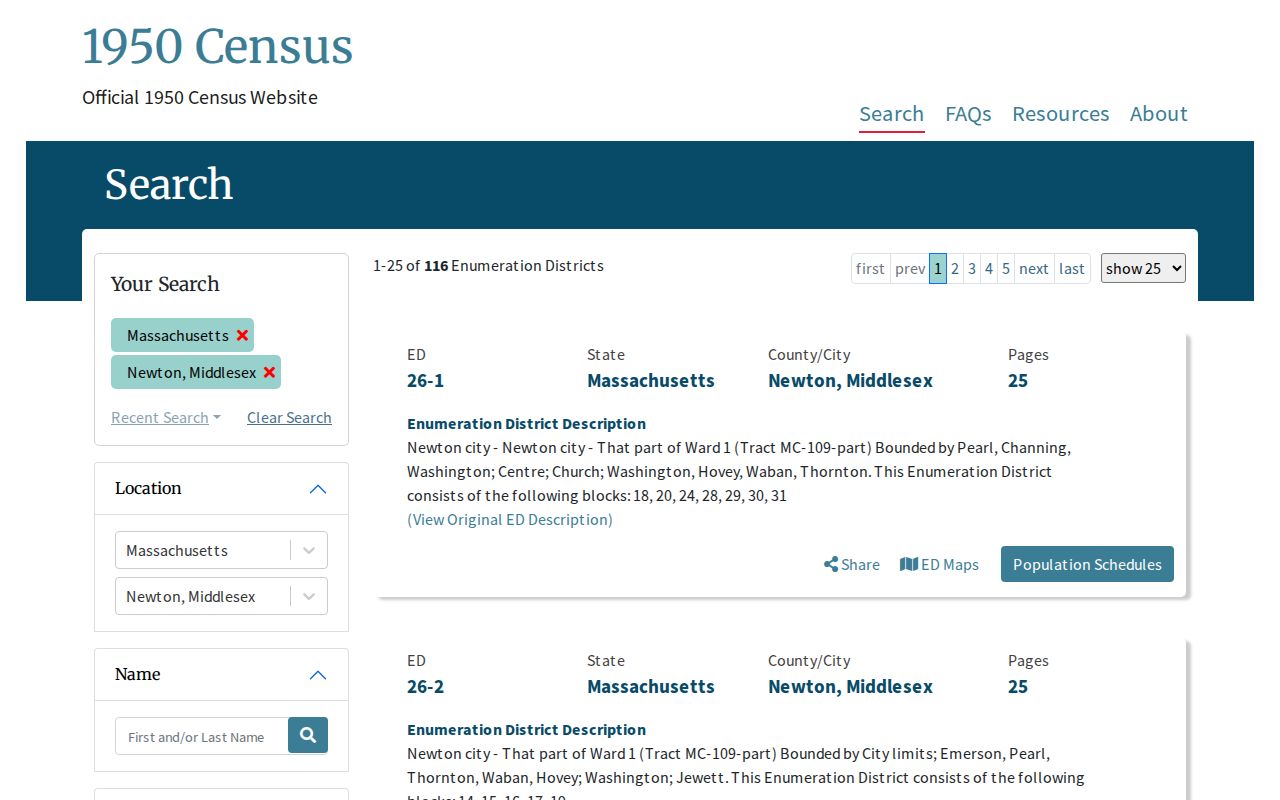
The search screen supports the district-based approach needed when an address, village form, or OCR result makes a direct name match uncertain.
Newton Map and Permit Records
Newton maps and permits date the place rather than a whole household. Newton Free Library lists Newton atlases from 1700, 1855, 1874, 1895, 1907, and 1917, plus Sanborn material. The Library of Congress holds a March 1892 Newton Sanborn set. Record the sheet number, address, lot shape, building form, neighboring streets, and date. Compare those details with the Newton parcel geometry and legal description. A map is a snapshot, not title evidence.
Newton Inspectional Services directs online Newton permit searching to ViewPoint, though the inspected public fields were not text-exposed. Its Plan Search form accepts date, property address, permit number or date, and requester details. A permit-number search costs $25 per permit, is pickup only, and requests before 1911 are not accepted. An online permit can point to work and a date, but a permit applicant is a record-specific role, not necessarily a resident.
For material outside a portal, Newton's public-record request process asks for a specific department, date range, and preferred electronic delivery. Under the Massachusetts Public Records Law, the city generally responds, supplies, allows inspection, or denies within 10 business days unless an allowed extension applies. Exemptions and protected information still apply.
Newton Address Record Limits
Newton address continuity can break on a village label, an abbreviation, a number suffix, or Newton Centre versus Newton Center. No authoritative Newton street-renumbering year was located. Instead, bridge a suspected Newton change with cross streets, atlas or Sanborn evidence, parcel shape, adjacent properties, the legal description, and the address form printed in each record. A postal ZIP should not decide Newton record jurisdiction, especially around Chestnut Hill.
Newton newspapers and obituaries can close a trail by providing a death, relationship, move, or date. Newton Free Library has Newton newspaper microfilm from 1866-2020, Newton Graphic material from 1882-1997 with digital issues through 1986, and Newton Tab material from 1979-2022. Its biography index and obituary cards are leads, not complete proof. Probate may name an executor or heirs, but the Middlesex Probate and Family Court remains the custodian for those Newton files.
Lawful personal use. Newton previous-resident research fits house history, family history, heir questions, and personal curiosity. Do not use an address trail to stalk, harass, or harm any person, and do not try to reverse a protected substitute address.
Massachusetts Address Confidentiality Program participants can use substitute addresses and mail forwarding. Protected voter or address procedures may also affect a result. A record that is absent, redacted, or tied to a substitute address is a limit to respect, not a prompt to search around it.